
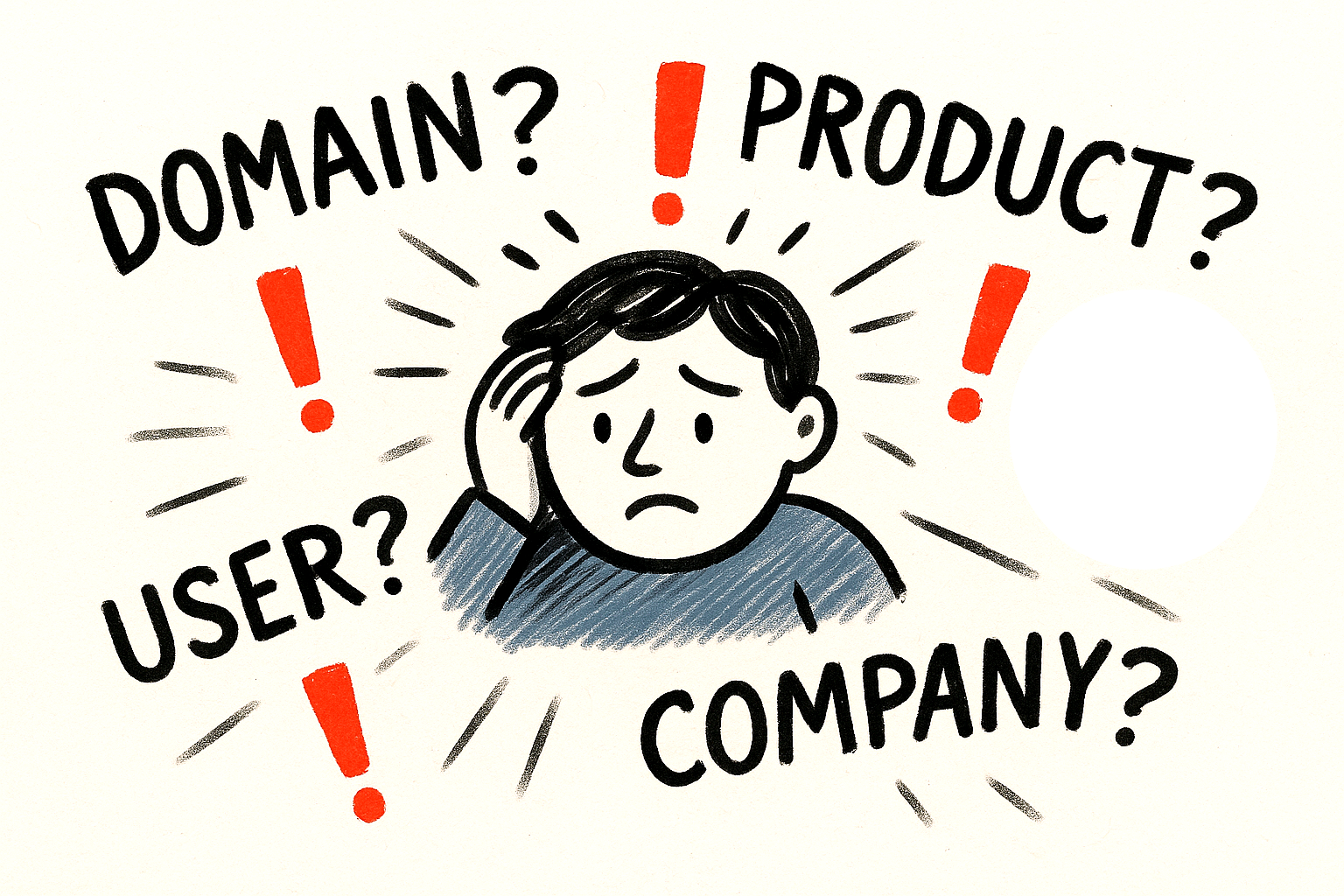
For those of you not familiar with impostor syndrome, first of all, bless you. Secondly, picture this:
You’re three weeks into a new job. You’re in a meeting with product managers who’ve been working on this healthcare platform for three years. They’re debating whether to call something a “care plan” or a “treatment protocol,” and you have no idea what either term means.
But you’re the content designer. You’re supposed to know what to call things. You’re the expert on clarity, on user mental models, on information architecture. They’re looking at you expectantly.
You feel like a fraud.
Here’s what nobody tells you: this feeling isn’t a bug in your psychology. It’s a feature of the role.
Content designers face a unique professional paradox: you’re hired as an expert, but you know nothing about the domain. You’re expected to write authoritatively about products you’ve never used. You need to make confident recommendations about users you just met. And your work looks “done” immediately—unlike a designer’s rough sketch or an engineer’s prototype—so mistakes are more visible. I like to say from agency and consulting “We get really good really fast, but we go so fast we don’t know if we’re actually any good.”
Most career advice treats this as a personal failing. “Get over impostor syndrome.” “Build confidence.” “Fake it till you make it.”
That advice is worse than useless. It’s actively harmful.
Impostor syndrome exists, but it’s also been abused, and to be frank, the term is unconsciously being used to gaslight designers into feeling bad about feeling bad. If your current efforts to deal with impostor syndrome are flagging, consider a reframe:
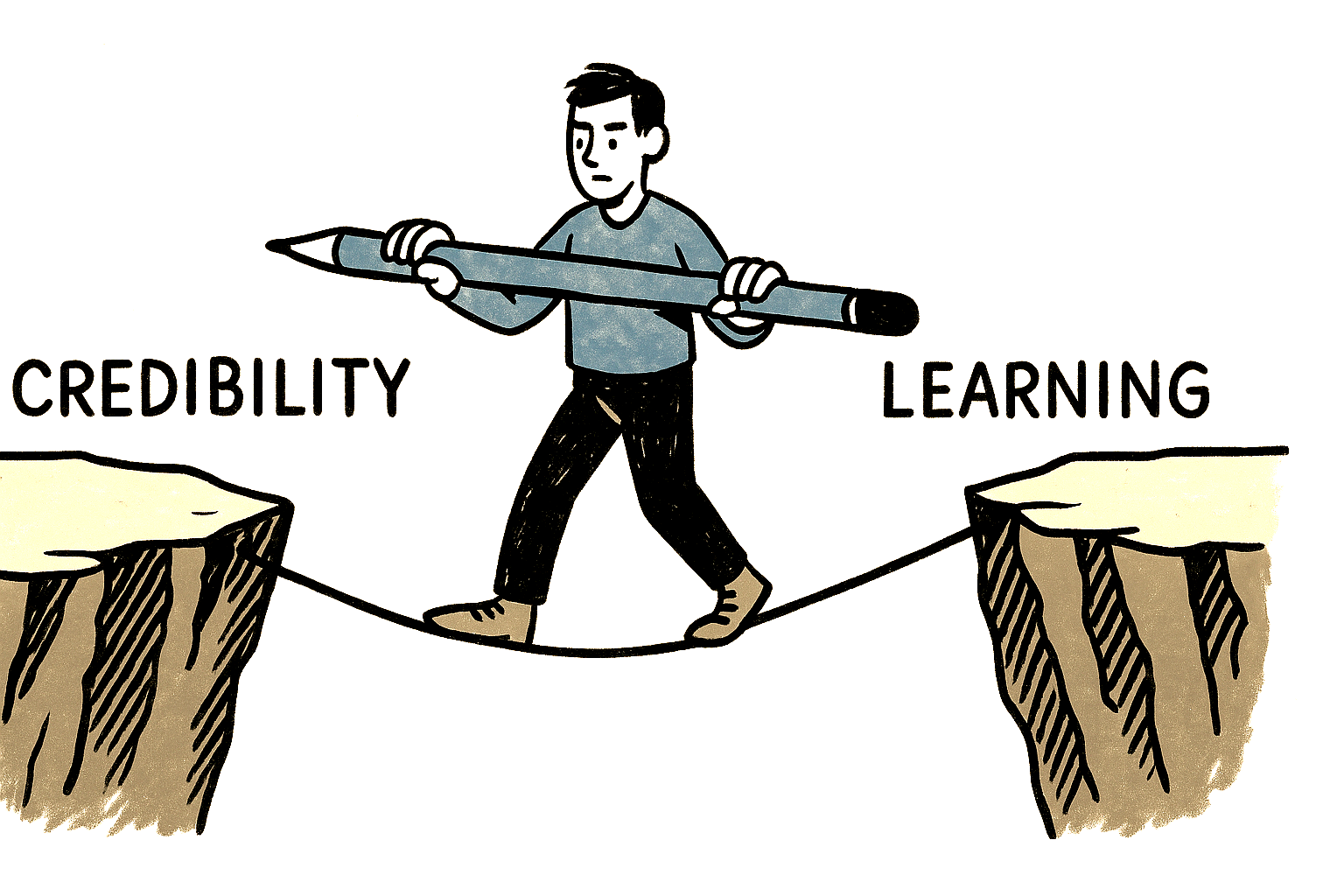
Try “credibility-learning tension”. It’s the exact same thing, it’s not a psychological flaw to overcome—it’s a vital professional superpower to develop.
We’ve known about credibility-learning tensions for almost a decade
In 2018, Bourgoin and Harvey published groundbreaking research in Harvard Business Review about how consultants manage expertise. They identified the “learning-credibility tension” that defines knowledge work: “Young management consultants may be novices, but they’re sold as experts. Conversely, even experienced consultants... still feel like novices when they embark on a new project.”[1]
You feel like it’s impostor syndrome, but it’s something deeper; it’s structural reality. The researchers found consultants in their study face three types of threats:
- Competence threats: Being seen as incompetent
- Acceptance threats: Being rejected by the team
- Productivity threats: Not delivering value quickly enough
Sound familiar? Content designers face all three, often at the same damn time and twice on Sundays.
But here’s the crucial reframe: Bourgoin and Harvey found that successful consultants aren’t “faking it ‘til they make it” in a cynical way. They’re “faking it so that they can make it.” Their “fakery is not cynical, but sincere”—it’s a professional necessity that enables learning while maintaining credibility.[1]
Why content designers face this uniquely
Every role involves learning. But content designers face a particularly acute version of the credibility-learning tension:
Your expertise is domain-agnostic, but your work is domain-specific
You’re an expert in clarity, mental models, information architecture, and user decision-making. But you have to apply that expertise to healthcare, or fintech, or supply chain logistics, or whatever domain your company operates in.
Unlike a designer who can sketch interfaces without deep domain knowledge, you have to use domain language correctly. You have to understand concepts well enough to explain them. You have to grasp user mental models that are shaped by domain-specific experience. But you’re expected to produce expert-level content from day one.
You have to sound confident about things you’re still figuring out
A designer can show rough sketches and iterate publicly. An engineer can commit experimental code and refactor. But when you write something, it looks finished. It’s in sentences. It sounds authoritative.
If you write tentatively, it reads as bad writing. So you have to write confidently about things you’re not yet confident about. This isn’t dishonesty—it’s professional necessity. But it creates internal tension.
Your work is more immediately legible than other roles
Everyone can read. Not everyone can evaluate code or critique visual design. This means more people feel qualified to have opinions about your work.
When you’re still learning, these opinions feel threatening. You can’t yet distinguish between “this person has good feedback” and “this person just prefers different wording.” So every comment feels like evidence that you’re a fraud.
Domain knowledge compounds faster than you can acquire it
Your coworkers have been here for years. They know the product history, the competitive landscape, the user research findings, the strategic context, the technical constraints. They reference all this casually in conversations.
This isn’t really impostor syndrome, is it? It’s barely a phenomena anymore. This is reality. And it’s not just you. And it requires specific strategies to navigate.
The “fake it” framework
Bourgoin and Harvey’s research reveals a crucial reframe: it’s not about “overcoming” the tension between credibility and learning. It’s about managing it productively.[1]
Successful consultants use three strategies: crafting relevance, crafting resonance, and crafting substance.
These aren’t about faking expertise. They’re about making legitimate expertise legible while you acquire domain-specific knowledge.
Crafting relevance: Show you understand the problem even when you don’t know the solution
You don’t need to know the answer to demonstrate expertise. You need to show you understand the problem in sophisticated ways.
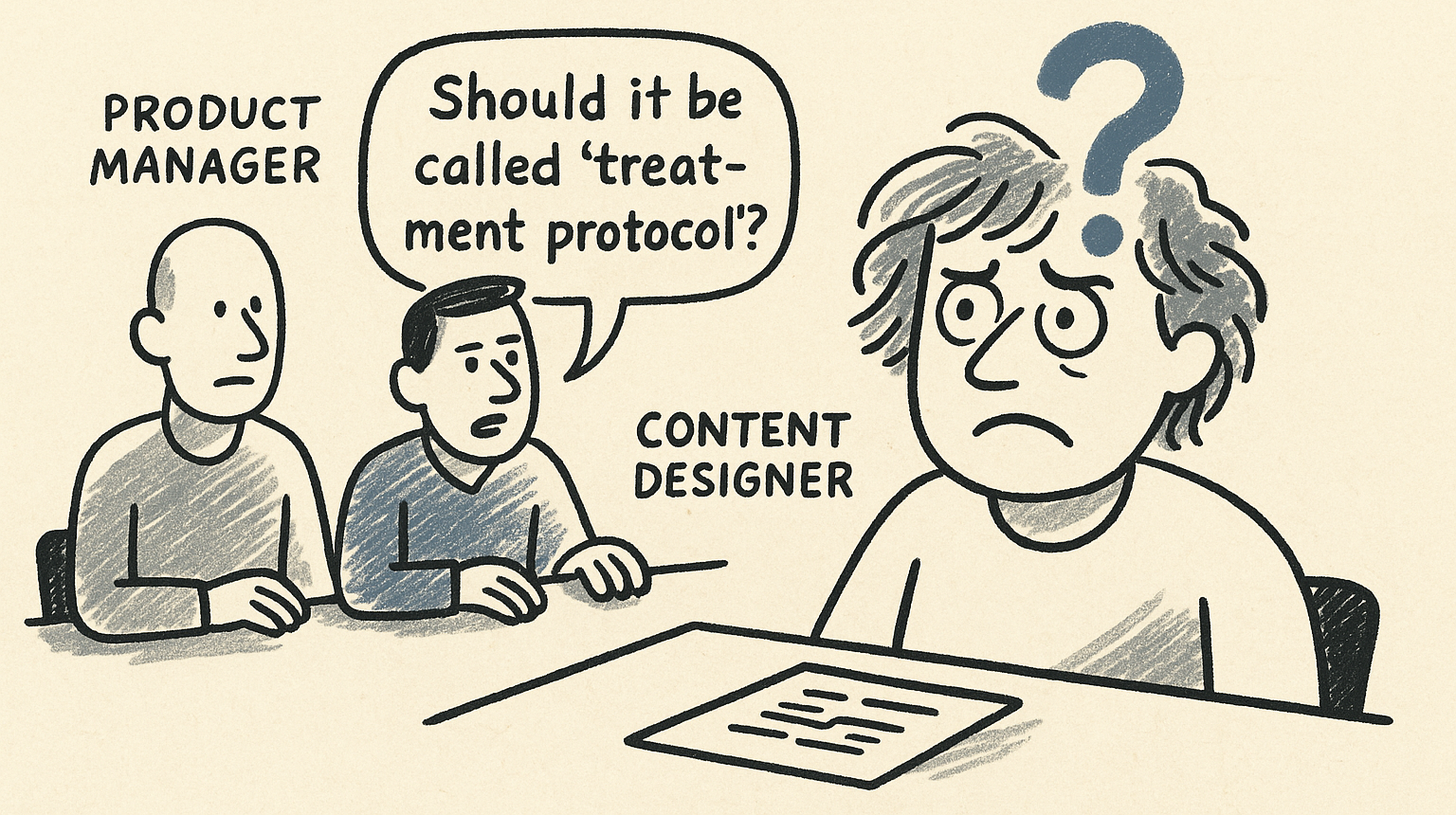
When that PM asks whether to call it a “care plan” or “treatment protocol,” you don’t need to know healthcare terminology. You need to show you understand the strategic question:
“This seems like it’s really about whether we’re aligning with clinical language that providers expect, or using more patient-friendly language that might be clearer but less familiar to our professional users. Have we tested both with the target users?”
You’ve shown:
- You understand this isn’t just a naming preference
- You grasp the user mental model question
- You know how to resolve it (testing)
- You’re thinking strategically about the tradeoff
You didn’t answer the question. You showed you understand what kind of question it is. That’s credibility.
Crafting resonance: Connect patterns from past experience to current challenges
You don’t need domain expertise to contribute expertise. You need to connect domain-agnostic patterns to domain-specific situations.
“When I worked on banking products, we faced something similar: industry jargon that users didn’t know but that signaled credibility to professional users. We ended up using the professional term with a plain-language explanation on first reference. Could that approach work here?”
You’ve shown:
- You’ve solved analogous problems
- You recognize patterns across domains
- You can adapt solutions, not just apply templates
The domain is different. The pattern is the same. You’re demonstrating transferable expertise.
Crafting substance: Do backstage preparation while maintaining front-stage expertise
This is where the real work happens. Publicly, you project confidence and competence. Privately, you’re learning obsessively.
The key insight from the Bourgoin and Harvey: the work of learning is invisible. The performance of expertise is visible. Both are legitimate. Both are necessary.[1]
Successful content designers do intense backstage learning, not limited to:
- Read everything you can access about the product
- Review past user research
- Interview subject matter experts
- Study competitor content
- Consume industry publications
- Lurk in customer support channels
But they don’t make the learning process publicly visible in ways that undermine credibility. They don’t say “I don’t know anything about this domain” in stakeholder meetings. They say “Let me review the existing research and come back with recommendations.”
Same reality. Different framing. The first signals incompetence. The second signals thoroughness.
Your timeline to competence is as long as a string
How long does it take to feel competent in a new domain? There’s a nagging Gallup stat: “It takes 12+ months for most people to get ‘up to speed’ in most jobs.” Underscore “most”. This isn’t a content design problem—it’s universal. But additional factors make it harder for us:[2]
- “Roughly 1 in 10 employees strongly agree that their organization does a good job of onboarding”
- “Organizations often lose one-third to two-thirds of new hires within their first 12 months”
- “About half of all hires for senior positions leave within 18 months”
And when it comes to content work, some of it is a plus-one to people in our shadow org, where they had greatness thrust upon them but it’s not their day gig.
Analysis came out to also debunk the Malcolm Gladwell “10,000 hour rule.” They found deliberate practice hours predicted only 26% of skill variation in games, 21% for music, 18% for sports. In chess, hours to reach master status ranged from 728 to 16,120—some players needed 22x more practice than others.
There’s no magic timeline. Individual variation is enormous. Quality matters more than quantity. And expecting quick mastery is unrealistic.
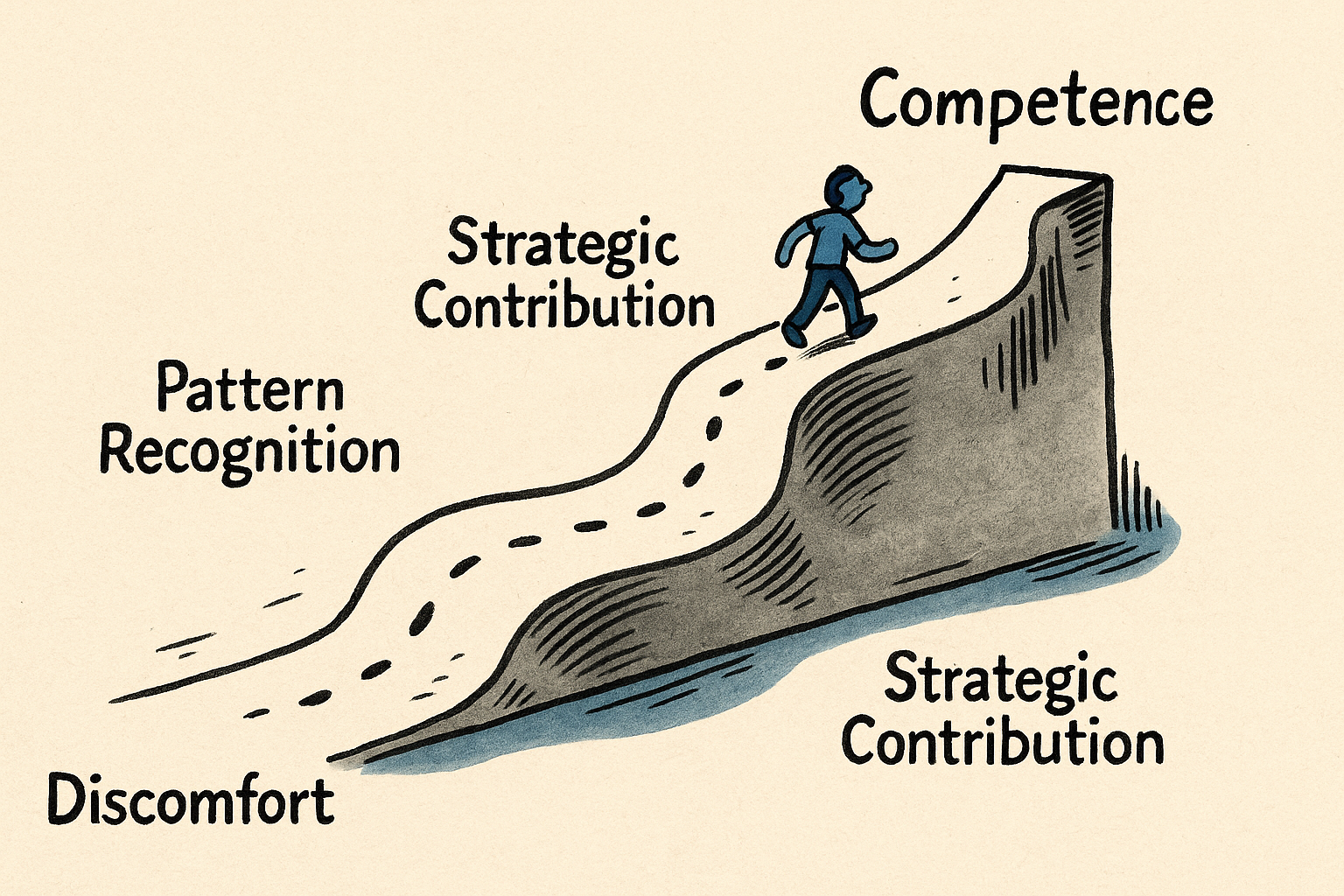
Here’s what you can expect:
Weeks 1-4: Maximum discomfort
Everything is new. You’re drinking from a firehose. You feel behind constantly. Every conversation includes terms you don’t know. You’re learning the product, the team, the politics, the jargon simultaneously.
This is the hardest phase. Your credibility is lowest when the learning curve is steepest. Manage expectations: “I’m going to ask a lot of questions in my first month as I get up to speed.”
Months 2-3: Pattern recognition
You start recognizing patterns. Not everything is new. You have context for conversations. You know who knows what. You can make meaningful contributions, not just ask questions.
This is when strategic learning kicks in. You’re not just absorbing—you’re targeting. “I need to understand X to solve Y problem.”
Months 4-6: Strategic contribution
You understand enough to identify gaps and opportunities. You can challenge assumptions productively. You’re not just executing—you’re shaping strategy.
This is when you shift from learning the domain to using the domain to do content work.
After 6 months: Domain competence
You’re no longer actively learning basic domain knowledge. You’re contributing domain insights. You might not be as expert as someone who’s been there for years, but you’re competent enough that the domain isn’t the limitation—your content expertise is the value.
This timeline assumes intensive learning. If you’re not deliberately building domain knowledge, it takes longer. Gallup’s 12+ month estimate is probably conservative for complex domains.[2]
Specific tactics for content designers
Here’s how to apply these strategies to content design work, informed by research on what actually works:
Use “strategic ignorance” to ask questions that sound smart
So how do you not get called out in that first year? You’re not faking expertise—you’re using your outsider perspective as an asset.
Instead of: “I don’t know what that means.” Try: “Help me understand the user’s mental model here—when they encounter this term, what prior knowledge are we assuming?”
Instead of: “I’m confused about how this works.” Try: “Walk me through the user journey—where does this fit in their understanding of the overall process?”
These questions acknowledge gaps while demonstrating strategic thinking—what Bourgoin and Harvey call “crafting relevance.”[1]
Make content creation a discovery process
Writing forces precision that thinking and talking don’t. Use this.
When you don’t fully understand something: “Let me try writing this and see what questions emerge. Often the attempt to explain something clarifies where our understanding has gaps.”
You’re learning through writing. But you’ve framed it as a content design methodology, not as ignorance. This is “crafting substance” in action.[1]

Create learning as official content design work
Make your learning process visible—but frame it as professional rigor, not ignorance.
Content audits are learning disguised as work: “I’m going to audit existing content to understand our current voice and identify inconsistencies.”
You’re actually learning the product, terminology, and strategy. But it looks like thorough content work.
Para et al.’s research supports this approach: making the learning process explicit and systematic reduces impostor feelings while building actual expertise.[3]
Document what you’re learning in shareable artifacts
As you learn, create artifacts that demonstrate expertise while encoding what you’ve learned.
Terminology guides: As you figure out what terms mean and how to use them, document it. You’re creating value for others while consolidating your own learning.
This aligns with research showing that “offering support in a group context” is a primary intervention for impostor phenomenon. Your artifacts help others while establishing your expertise.[3]
Build alliances with subject matter experts
You don’t need to become the domain expert. You need to know who the domain experts are and how to work with them effectively.
Position yourself as a translator, not a learner: “I need to understand this well enough to explain it clearly to users. Can you walk me through the key concepts?”
You’re framing your learning as translation work—which is your actual job. This maintains credibility while enabling learning.
Accept that some discomfort is permanent
Even experienced content designers feel this tension when they join new domains. It doesn’t fully go away—you just get better at managing it.
The research is clear: impostor syndrome is “a stronger predictor of mental health issues than minority status stress” (Para et al., 2024). But when reframed as credibility-learning tension—a professional skill rather than a personal failing—it becomes manageable.[3]
Not: “I feel like a fraud because I don’t know enough.”
Instead: “I’m in the learning zone, which is exactly where growth happens.”
Not: “Everyone else knows more than me.”
Instead: “Everyone else knows different things. I know content, mental models, and clarity. That’s why I’m here.”
This reframe matters because it changes how you behave. When you think it’s impostor syndrome, you try to hide your learning. When you understand it’s a professional skill, you manage it strategically.
How to know you’re getting better
Managing credibility-learning tension is a skill. You get better with practice. Here’s what improvement looks like:
You catch yourself earlier
At first, you panic when you don’t know something. Eventually, you recognize the feeling and shift to strategic mode faster. “I don’t know this yet, so I’ll frame my question to learn while appearing thoughtful.”
Your questions get sharper
Early questions are vague: “What does this do?” Later questions are strategic: “What problem does this solve for users, and what do they need to understand to use it successfully?”
You’re still learning. But you’re learning more efficiently because you know what questions extract useful knowledge.
You spot gaps others miss
As you learn the domain, you notice where explanations are unclear, where logic is fuzzy, where assumptions are unfounded. Your outsider perspective becomes valuable expertise.
You contribute domain insights
Eventually, you understand the domain well enough to push back on domain experts. “Actually, I think users’ mental model is different than we’re assuming. Let me show you the research.”
You help others manage their credibility-learning tension
When junior content designers join, you can teach them: “This feeling is normal. Here’s how to manage it. Here’s what worked for me.”
The competitive advantage of strategic learning
Here’s the paradox: content designers who are comfortable with credibility-learning tension often become better domain contributors than people who’ve been in the domain for years.
Why? Bourgoin and Harvey’s research suggests it’s because the learning process itself creates unique value:[1]
You ask questions experts stopped asking
People who’ve been in a domain for years stop questioning assumptions. You have to question everything to learn it, which often reveals that the “obvious” way isn’t obvious at all.
You see patterns across domains
Domain experts know their domain deeply but often lack cross-domain perspective. You bring patterns from other industries, other products, other contexts. This makes you valuable in ways that domain tenure alone can’t match.
You’re forced to explain things clearly
Domain experts often communicate in jargon because they forget what it’s like not to know. You have to explain things to yourself to understand it, which makes you better at explaining it to users.
You document what experts keep in their heads
When you learn something, you write it down. When an expert knows something, they just know it. Your artifacts create organizational value that expertise alone doesn’t.
The credibility-learning tension, managed well, becomes a competitive advantage. Not despite the learning curve, but because of it.
Growth means embracing uncertainty
Content design is still here. Part of that stage of maturity is accepting that we’ll never know everything, and that’s okay. We crave certainty. We need to feel expert in everything. We’re threatened by gaps in knowledge.
The pros are comfortable with uncertainty. They know what they know, they know what they don’t know, and they know how to bridge the gap.
The credibility-learning tension isn’t a bug to fix. It’s the terrain of the job. The question is whether you fight it or learn to navigate it skillfully.
Every content designer feels this. The best ones just manage it better. They’ve learned that projecting expertise while actively learning isn’t fraud—it’s professionalism.
Interventions work. Training helps. Group support and community helps. Recognition that this is normal helps. But first, we have to name it correctly: it’s credibility-learning tension.[3]
Welcome to the tension. Learn to work with it. It’s where all the growth happens.
This is the final article in a series on growing with content design. Read the other articles in the series:
 Scott Pierce
 Scott Pierce
 Scott Pierce
References
- Bourgoin, A., & Harvey, J.-F. (2018). How consultants project expertise and learn at the same time. Harvard Business Review.
- Para, E., Dubreuil, P., Miquelon, P., & Martin‑Krumm, C. (2024). Interventions addressing the impostor phenomenon: A scoping review. Frontiers in Psychology.
- Bravata, D. M., et al. (2020). Prevalence, predictors, and treatment of impostor syndrome: A systematic review. Journal of General Internal Medicine.
- Gallup Workplace. (2023). Essential ingredients for an effective onboarding program.
- Macnamara, B., et al. (2023). Meta‑analysis on deliberate practice. Case Western Reserve University.