
Where content principles meet the context ecosystem… and why the overlap matters more than either one alone.
Most content conversations stay in one of two lanes.
There’s the craft lane: tone, clarity, word count, whether the microcopy on that button earns its keep. And there’s the systems lane: how content moves through an organization, who touches it, what happens when it scales beyond the team that wrote it.
These lanes don’t talk to each other enough. That’s a problem, because the place where they overlap is exactly where content either holds up or falls apart.
Two frameworks, one pressure point
I’ve been thinking about this overlap through two lenses.
The first is a set of content principles I use to evaluate whether a piece of content is actually doing its job — not just existing, but earning the attention it’s asking for. Things like: did we answer the user’s question first? Did we match tone to what’s actually at risk? Can the user get out if they need to?
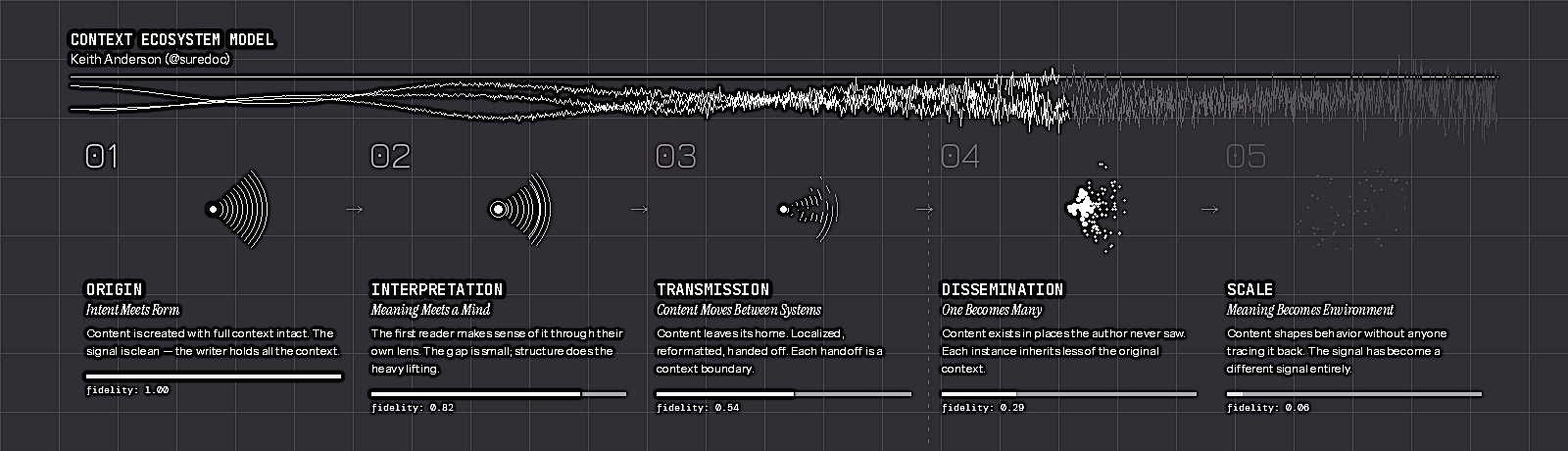
The second is the Context Ecology Model, developed by Keith Anderson. It runs through the stages of context. The CEM maps how content operates within larger systems, like how context flows between creators, platforms, and audiences. Here’s my take, riffing on the framework as I understand it from how we’ve been working with it:
Origin: Intent Meets Form. This is where content is created with full context intact. The writer knows the audience, the stakes, the moment. Every word choice carries the weight of that understanding. The signal is clean because the person shaping it holds all the context.
Interpretation: Meaning Meets a Mind. The first reader encounters the content and makes sense of it through their own lens. Even here , one step from away, some context shifts. What the writer meant and what the reader understood aren’t identical. But the gap is small, and the original structure still does most of the heavy lifting.
Transmission: Content Moves Between Systems. The content leaves its original home. It gets localized, reformatted, dropped into a CMS, handed to a partner, picked up by an API. Each handoff is a context boundary. The content survives if the craft was structural… if meaning lives in the bones, not just the skin.
Dissemination: One Becomes Many. The content now exists in multiple places, serving multiple audiences, in formats the original author never saw. This is where “write once, publish everywhere” reveals the benefits come with a cost. Each instance inherits less and less of the original context. The message is recognizable but no longer whole.
Scale: Meaning Becomes Environment. The content is no longer a discrete thing someone reads. It’s part of the atmosphere. It shapes decisions, expectations, and behavior without anyone tracing it back to the original intent. This is where Anderson’s rule kicks hardest: context at scale doesn’t just degrade, it reconstitutes into something the origin never intended. The signal hasn’t just lost fidelity — it’s become a different signal entirely. One of its key rules is that context at a certain scale tends to break down. Not might. Tends to.
That rule is doing a lot of work. And it connects directly to why content principles exist in the first place.
Worth noting: these stages aren’t always linear. Content can jump from Origin straight to Scale (think a viral error message), and the model’s real value is in showing that each boundary is a place where craft either holds or doesn’t.
What “context breaks down at scale” actually looks like
Here’s a concrete example. You write a clear, honest error message for a payment failure. It says what went wrong, what the user can do, and what happens next. It respects their attention. It matches tone to stakes — no chirpy “Oops!” when someone’s rent payment just bounced.
That message works beautifully in the flow you designed it for.
Now multiply it. That same payment platform serves twelve markets, four product tiers, and three partner integrations. The message gets localized, repurposed, and dropped into contexts you never anticipated. A partner app strips the “what to do next” section because it doesn’t fit their UI. A localization team translates the words but loses the tone calibration. An AI system generates a variant that opens with two sentences of context-setting before getting to the fix.
The craft was right. The context ecosystem ate it.
This is Anderson’s model in action. The message didn’t get worse because someone made a bad decision. It degraded because scale introduced entropy. Context leaked out at every handoff.
Where the principles become load-bearing
Content principles aren’t style preferences. They’re structural decisions about what content has to survive — even when the ecosystem pushes against it.
Take “Lead with what users need.” In a single-product team, that’s a writing tip. In a content ecosystem with syndication, localization, and AI-assisted generation, it’s an architectural constraint. If the first sentence doesn’t carry the answer, every downstream system that truncates, reformats, or summarizes your content will cut the part that matters most. You’re not just writing clearly. You’re writing for degradation.
Or “Provide escape hatches.” In a design review, that’s a UX consideration. In the context ecosystem, it’s a survival mechanism. When content moves through systems you don’t control — partner integrations, embedded widgets, aggregated feeds — users end up in flows they didn’t choose. If you didn’t build the bailout into the content itself, no one downstream is going to add it for you.
“Be honest about limitations” is another one that changes meaning at scale. When you write “usually takes 3–5 days” instead of “fast shipping,” you’re not just being more trustworthy in the moment. You’re writing content that won’t generate support tickets when it lands in a context where “fast” means something different than you intended. Honesty scales. Vagueness compounds.
The craft-systems feedback loop
Here’s what I think both frameworks are pointing at:
Craft without systems thinking produces content that works in a vacuum. Systems thinking without craft produces content that scales efficiently and fails users at every touchpoint.
The content principles answer the question “Is this piece of content doing right by the person consuming it?” The Context Ecosystem Model answers the question “What happens to this content after it leaves our hands?”
You need both questions. Because writing a respectful, clear, well-calibrated message doesn’t matter if it’s going to get shredded by the ecosystem it enters. And building a sophisticated content system doesn’t matter if the content flowing through it doesn’t hold up its end of the deal.
“Acknowledge before asking” is a perfect example of the feedback loop. At the craft level, it means explaining why you’re collecting someone’s phone number before you ask for it. At the systems level, it means that explanation has to travel with the form — not live in a separate onboarding flow that half your users skip, or in a tooltip that gets stripped by a partner’s implementation.
The principle tells you what the content needs to do. The ecosystem tells you what it needs to survive.
So what do you actually do with this?
Three things.
First, stress-test your content principles against scale. For each principle, ask: does this still hold when the content is three handoffs away from the person who wrote it? If not, the principle needs to be expressed in the content itself, not in the process around it.
Second, use the Context Ecosystem Model to identify where your content is most likely to degrade. Those are the places where your principles need to work hardest — where “match tone to stakes” isn’t a nice-to-have but a structural requirement.
Third, stop treating craft and systems as separate disciplines. The best content strategists I know are already doing this intuitively. They write a button label and simultaneously think about what happens when that label gets pulled into a notification, an email, a third-party integration. They’re doing craft work and ecosystem work in the same breath.
Content principles tell you what good looks like. The context ecosystem tells you what good is up against. The overlap between the two is where the real work lives.
The Context Ecology Model was developed by Keith Anderson @suredoc. If you’re building content systems at any meaningful scale, his work on how context degrades across ecosystems is worth your time:
https://suredoc.medium.com/
https://www.linkedin.com/in/suredoc/
https://www.resilientcontext.com/