
Okay, I know it’s been a hot minute, but between wrangling family things and a Button conference, it was a slog to get to this follow-up. The real issue was, having been in this for a third of my life, this one fact was a hard one to swallow, digest and serve back up. No, not “nobody’s coming to save you”.
For years, we promised salvation through structure. Create Once, Publish Everywhere. Single Source of Truth. One canonical version maintained centrally, flowing seamlessly to every channel, perfectly consistent, always current.
It was elegant. It was efficient. It was the answer to content chaos.
For most organizations, and especially in short-run client engagements, it was also at best a “really good idea” that never got budget, sponsorship or traction.
We built the artifacts—structured content, taxonomies, content management systems—and waited for the efficiency to arrive. We create the one source, we publish everywhere, and then we discover that “everywhere” now has different requirements, different contexts, and different user needs.
Automation and Generative AI came it to really shine a light and exacerbate the problem: The product description that works on your website doesn’t really work in your mobile app. The help article that serves beginners ironically confuses experts. The English content that’s clear and friendly becomes stilted and awkward when literally translated to Japanese. The carefully crafted message that sounds perfect in email feels intrusive as a push notification.

When “single sourcing” cracks, coherence is like toothpaste: it flows where it’s needed most.
So we create exceptions. And variations. And overrides. And context-specific versions. Until our “single source of truth” has so many special cases that it’s effectively multiple sources with a governance headache.
We were fighting reality. And reality was winning.
The dream of single source of truth, if not dead, is retired to Florida. It might have been killed by personalization, stowed in the trunk by AI, and buried by the realization that context matters more than consistency.
It’s time to pay respects, and in its honor start adapting an idea that has been working in design: distributed coherence. I didn’t invent the term, but was heavily inspired by architecture, namely:
So what the what is “distributed coherence”?
Distributed coherence is about focusing less on consistency for consistency’s sake, but maintaining harmony without sacrificing contextual relevance and creative adaptation. Coherence in that article is described as “a subtle alignment that lets a group move as one. Like a body, where each part moves independently but stays in sync with the whole.”
It should begin with clear principles that guide that contextual adaptation rather than rigid templates or single sources of truth. It means:
- Keeping your message consistent while letting the expression breathe: Your core message stays solid across channels, but you don’t force the same exact words everywhere. The TikTok version shouldn’t match your whitepaper word-for-word.
- Using principles instead of templates: Give your teams guardrails, not straitjackets. Let them adapt to each channel while staying true to what matters.
- Thinking systemically, starting with chunks: Stop seeing content as isolated pieces to be duplicated. It’s an ecosystem where each piece works with others to create something coherent.
The reality? Context changes everything. Those perfectly crafted words that sing on your website might fall completely flat in a push notification or sound robotic coming from Alexa.
This isn’t about throwing consistency out the window; it’s about being smart about where consistency actually matters (the meaning, the purpose, the principles) versus where variation is essential (the expression, the format, the level of detail). It’s acknowledging that personalization, AI generation, and multichannel experiences demand flexibility that old-school SSOT simply can’t deliver.
Why we wanted SSOT (and why it seemed possible)
The appeal of single source of truth wasn’t arbitrary. It solved real problems:
Efficiency through reuse Maintain content once instead of maintaining dozens of copies. Update in one place, and it updates everywhere. No more chasing down all the places that mention your pricing model when it changes.
Consistency through centralization One source means one version of truth. No contradictions. No drift. Users get the same information regardless of how they access it.
Control through governance Clear ownership. Clear process. Clear version history. You know what’s published, who published it, and when it changed.
Scalability through structure Structured content that can be systematically managed, searched, and delivered. Content as data, not just documents.
These goals made sense, and the data supported them. Contentful’s 2024 research found that 68% of brands say consistency contributed 10-20% of their revenue growth. No wonder we chased the SSOT dream.
These aren’t bad goals. They’re just insufficient for the reality of modern content.
The SSOT model worked (sort of) when:
- Content was mostly informational, not conversational
- Distribution channels were limited and similar (web, print, maybe mobile web)
- Personalization was minimal (maybe logged in vs. logged out)
- Translation meant literal word-for-word conversion
- Content was primarily human-authored and human-curated
None of those conditions exist anymore.
What killed SSOT (or made it less real)
Personalization
McKinsey’s 2024 research is definitive: companies excelling at personalization drive 40% more revenue than slower-growing counterparts. 71% of consumers expect personalized interactions. 76% get frustrated when personalization doesn’t happen. And personalization delivers 10-15% revenue lift (ranging from 5-25% by sector).
When you show different content to different users based on their behavior, needs, context, and history, you can’t have “one version of truth.”
Your product description for a beginner needs to explain basic concepts. Your product description for an expert assumes fluency and focuses on advanced capabilities. These aren’t variations on the same content—they’re fundamentally different content serving different needs.
McKinsey found that “over three-quarters of consumers (76 percent) said that receiving personalized communications was a key factor in prompting their consideration of a brand, and 78 percent said such content made them more likely to repurchase.” This level of personalization is incompatible with single-source approaches.
Contentful’s own research drives this home: 89% of companies consider personalization essential for business success over the next 3 years. Yet 57% struggle with data inconsistencies when personalizing—exactly the problem SSOT was supposed to solve but can’t. (Contentful, 2025)
AI and LLMs
With large language models, content is increasingly generated, summarized, and adapted on the fly. The “source” isn’t a document—it’s a model, training data, and a prompt.
McKinsey’s 2024 State of AI research found that 78% of organizations have adopted AI in at least one business function, up from 55% the year before. 71% use generative AI regularly, with 63% creating text outputs. The scale is staggering and accelerating.
Your chatbot doesn’t retrieve “the answer” from a knowledge base—it generates an answer based on context, user history, and conversation flow. Every response is unique. Unlike virtual assistants with relevant chunk of content, there’s no canonical version to point to.
The quality challenge is real. McKinsey found significant variation in how organizations handle AI content: 27% review all generated content before use, while a similar share reviews 20% or less. This isn’t a governance problem you can solve with SSOT—it’s a fundamental shift in how content is created.
As McKinsey noted: “The value of AI comes from rewiring how companies run... the redesign of workflows has the biggest effect on an organization’s ability to see [profitability from operations] from its use of Gen AI.” Static content repositories don’t really fit this model.
Localization
We told ourselves: “Single source, many translations.” We’d write once in English, translate systematically, and maintain consistency across languages.
DeepL’s 2023-2024 State of Translation and Localization research with director-level marketers at 100+ employee companies revealed the reality
- 98% use machine translation
- 99% supplement with human review, yet…
- 82% struggle with accurately translating industry-specific terms
The report’s conclusion is stark: “This isn’t a passing trend; it’s the new standard. Businesses slow to adapt risk being overshadowed by those who have integrated these technologies into their localization efforts.”
But here’s the thing to remember: good localization isn’t translation—it’s cultural adaptation. You can’t have “one source” when 82% of companies struggle with industry-specific terms that require local context, not just linguistic conversion.
Channel appropriateness
Now, I want to make it clear: just because I’m popping off about SSOT doesn’t mean I hate COPE, in fact I love it done well. But “publish everywhere” is assumed by some teams that everywhere is equivalent. It’s not.
Kontent.ai‘s analysis in “Create Once, Publish Everywhere: Doing COPE Right“ exposes the fundamental flaw: “COPE doesn’t imply that a single version of content automatically works effectively in every channel all the time. You also need to consider the context where the content will be used.”
They documented extensive channel-specific requirements across 12+ channel types:
- Mobile apps need extreme brevity and touch-optimized interactions
- Chatbots require conversational flow and intent recognition
- Voice assistants demand sequential, audio-first design
- Email allows detail but requires subject line optimization
- Push notifications have character limits and urgency requirements
Their warning is plain as day: “COPE is a powerful concept that unfortunately gets misunderstood. Some developers assume that because the content can be technically delivered to different channels easily, all content is ready from an editorial perspective for any channel. That’s not necessarily the case.”
More damning: “When every channel becomes a separate silo, design operations and content operations can’t scale.” If misunderstood, the COPE model creates the very problem it was meant to solve.
Context is everything
Even within a single channel, context determines what content works.
Contentful’s 2025 research revealed a massive perception gap: 85% of companies believe they provide personalized experiences, but only 60% of customers agree. This gap exists because companies are delivering consistent content when users need contextually appropriate content.
The investment mismatch is telling: companies are allocating 40% of budgets to personalization (nearly double the 22% in 2023), yet 43% still struggle with accurate, real-time customer data. Only 24% effectively invest in omnichannel personalization.
Users arrive at content from different mental states, different prior knowledge, different goals, and different urgency levels. Pretending they all need “the same content” ignores what makes content actually work: perfect fit to context.
Moving into distributed coherence
If single source of truth doesn’t always work, what else do we have?
Distributed content with systemic coherence.
Instead of one source that publishes everywhere, you have principles and patterns that ensure meaningful consistency across distributed content.
Think of it like the difference between classical music and jazz:
- Classical music: Everyone plays the exact same notes from the sheet music (single source of truth)
- Jazz: Everyone plays from a shared structure (key, chord progression, tempo) but interprets it contextually (distributed coherence)
Jazz maintains coherence without rigidity. Each musician responds to the moment, to other musicians, to the audience. But they’re all working from shared principles that make their improvisation harmonious.

Content needs to work the same way. Kontent.ai articulated this need: distinguishing between “core content” (the foundation) and channel-specific adaptations. The core provides coherence; the adaptations provide relevance.
What distributed coherence looks like
Distributed coherence means:
Shared principles, varied execution You don’t need to publish the same content everywhere. You apply the same principles to create contextually appropriate content.
Principle: “Help users accomplish their immediate goal, then suggest related value”
- On web: Full explanation followed by related features
- In app: Brief action followed by one suggestion
- Via voice: Complete the task, offer one next step
- In email: Context-rich description with multiple paths
Same principle, completely different implementations.
Semantic consistency, surface variance The meaning remains consistent even when the words change.
Your privacy commitment is semantically the same everywhere: “We protect your data and give you control.” But the expression varies:
- Legal page: Detailed, precise, regulated language
- Marketing site: Benefit-focused, trust-building language
- In-app settings: Action-oriented, control-focused language
- Quick signup: Minimal, reassuring, link to details
Same meaning, contextually appropriate expression.
Pattern-based variation, not template-based replication Instead of filling templates with the same content, you provide patterns that teams adapt.
This aligns with McKinsey’s finding that successful AI implementation requires “the redesign of workflows” rather than simple automation. Patterns enable this redesign; templates prevent it.
Governance through principles, not through control You can’t control every instance of content. You can ensure every instance follows principles.
The data supports this approach. While 80% of C-suite executives cite lack of centralized oversight as a challenge (Contentful, 2024), the solution isn’t more control… it’s better principles. As 81% of brands struggle to maintain unified global brand identity, principles provide coherence that control can’t achieve.

Practical strategies for distributed coherence
How do you actually implement this?
1. Define your coherence markers
What makes your content recognizably yours? Not superficial things like “we use sentence case” but deep things like:
- How you treat user agency (do you tell them what to do, or give them informed choices?)
- How you handle complexity (do you simplify, or teach sophistication?)
- How you build trust (through transparency, through expertise, through empathy?)
- How you balance business and user needs (whose interests come first in conflicts?)
These are the non-negotiables that must remain consistent even when everything else adapts.
2. Create adaptive content patterns that support the principles
Instead of content templates, create content patterns that show:
- Required elements (what must be present)
- Contextual elements (what depends on situation)
- Adaptation guidance (how to modify for different contexts)
This approach addresses what Kontent.ai identified as the need for “core content” that’s adaptable rather than rigid.
3. Build decision frameworks, not approval processes
Teams need to make content decisions without central bottlenecks. Give them frameworks:
When to personalize vs. standardize McKinsey’s data shows personalization drives 40% revenue differential (McKinsey), but Contentful found only 24% effectively invest in omnichannel personalization. The framework helps teams know when to invest in variation.
When to be comprehensive vs. minimal Channel requirements vary dramatically. Push notifications need 60 characters; email can handle thousands. The framework helps teams optimize for each channel.
When to match source language vs. culturally adapt With 82% struggling with industry-specific translation and 99% requiring human review of machine translation (DeepL, 2024), teams need clear guidance on adaptation levels.
4. Establish content source types
Not all content needs the same approach to distribution:
Core content: Principle-driven, widely distributed, highly adapted
- Example: Product value propositions
- Approach: Define principles, let teams implement contextually
Reference content: Factually precise, minimally adapted, linked not embedded
- Example: Technical specifications, legal terms
- Approach: Maintain centrally, link from context-appropriate wrappers
Operational content: Highly templated, systematically generated, minimally varied
- Example: Transaction confirmations, system notifications
- Approach: Templates with variables, strict structure
Conversational content: Dynamically generated, principle-guided, never identical
- Example: Chatbot responses, AI-generated summaries
- Approach: Training data and principles, not static content
- Note: With 63% of organizations creating text with AI (McKinsey, 2024), this category is rapidly expanding
5. Measure coherence, not consistency
Stop measuring whether content is identical across touchpoints. Start measuring whether it’s coherently purposeful.
Coherence metrics aligned with business outcomes:
- Do users recognize they’re in your product across touchpoints? (Brand coherence)
- Can users accomplish goals regardless of channel? (Functional coherence)
- Does personalized content drive the 10-15% revenue lift McKinsey documented? (Value coherence)
- Can teams make decisions that maintain the 68% consistency-to-revenue correlation? (Operational coherence)
6. Document rationales on why you made variations
When content varies significantly across contexts, document why. This creates institutional knowledge and addresses the 57% who struggle with inconsistencies in personalization (Contentful, 2025).
7. Create content principle cards
Give teams a portable reference and play with what works across the 12+ channel types Kontent.ai identified:
Principle card: Content type-specific adaptation
- In mobile apps: Use extreme brevity and touch-optimized interactions
- In chatbots: Structure for conversational flow with intent recognition
- For voice assistants: Design sequential, audio-first content
- In email: Balance detail with subject line optimization
- For push notifications: Respect character limits and urgency requirements
- On websites: Optimize for various screen sizes and browsing patterns
- In social media: Follow platform-specific formats and engagement patterns
- For digital signage: Design for distance viewing and brief exposure
- In AR/VR experiences: Create spatial and interactive content design
- For wearable devices: Focus on glanceable, contextually relevant info
- In kiosks: Design for public use with intuitive navigation
- For print materials: Maintain readability without interactive elements
Principle: Respect user attention
- In high-attention moments (signup, checkout): Be complete and clear
- In ambient moments (browsing, exploring): Be minimal and scannable
- In interruption moments (notifications, alerts): Be brief and actionable
These cards help teams make contextually appropriate decisions that maintain coherence. Also, share your cards with me when you’re done. Post-it’s doodles, whatever!
What you gain by letting go
Abandoning single source of truth feels risky. Won’t we lose consistency? Won’t content quality suffer? Won’t governance break down?
Actually, the opposite happens:
Better quality through appropriateness Content that fits context works better than content that’s consistent but inappropriate. The 76% of users who expect personalization (McKinsey) prefer helpful variation over rigid uniformity.
More scalability through distribution When teams can create contextually appropriate content using principles and patterns, you scale faster than when everything routes through central control—addressing the bottleneck Kontent.ai warned about.
Greater adaptability through flexibility With 78% AI adoption and growing (McKinsey), flexibility isn’t optional. Principles work with AI; rigid templates don’t.
Better ROI through localization The 96% positive ROI from localization (DeepL) comes from adaptation, not translation. Distributed coherence enables the cultural adaptation that drives 3x returns.
Cleaner governance through clarity Instead of managing exceptions to the single source (which 80% of organizations struggle with), you manage principles. Governance becomes education, not gatekeeping.
The mindset shift required
Moving from SSOT to distributed coherence requires changing how you think about content:
From control to guidance You can’t control every instance. You can guide every decision. This is especially critical as AI generates more content—you guide models, not control outputs.
From templates to patterns Templates enforce uniformity. Patterns enable appropriate variation. With channels multiplying and personalization expected, patterns scale while templates break.
From central to distributed Central maintenance doesn’t scale. Distributed decision-making with shared principles does. The evidence is clear: 81% of brands fail at maintaining centralized consistency—it’s time to try something different.
From identical to coherent Identical content across contexts is false consistency. Coherent purpose across contexts is real consistency—and it’s what drives the revenue impact that 68% of brands have documented.
From content as artifact to content as system Content isn’t documents to manage. It’s a system of principles, patterns, and practices. This system view is essential for AI integration and omnichannel delivery.
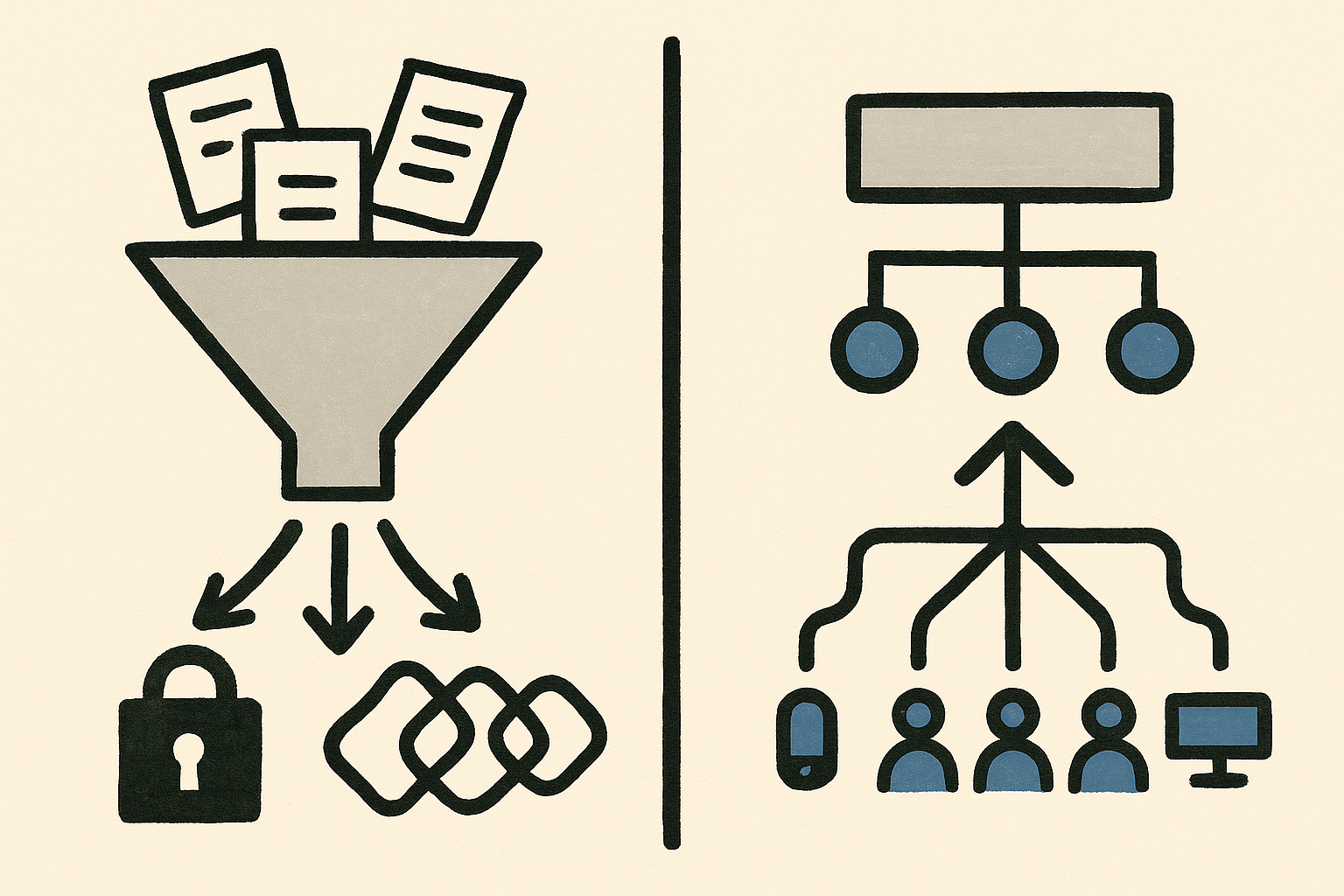
This mindset shift is hard. We’ve invested years in SSOT infrastructure. We’ve built processes around central control. We’ve sold stakeholders on the efficiency of “create once, publish everywhere.”
But the reality is clear in the data: we’re already maintaining distributed content. We’re just pretending it’s single-source while managing dozens of exceptions, overrides, and special cases.
Distributed coherence names what we’re actually doing and gives us better tools to do it well.
The growing pains
Single source of truth is the dream of perfect control. Distributed coherence is the mature acceptance that context matters more than uniformity.
Consumers expect contextual relevance, not consistent mediocrity.
We want rules that eliminate ambiguity. We need principles that enable good judgment in novel situations.
We want central authority to make all decisions. We need distributed capability to make contextually appropriate decisions.
We want consistency through rigidity. We need coherence through shared values.
The dream of single source of truth promised efficiency through control. The reality of distributed coherence delivers effectiveness through appropriateness.
This is part of a series on the maturity of content design.
To catch up, read the overview and keep going:
 Scott Pierce
 Scott Pierce
Coming next: “The credibility-learning tension: How content designers build expertise fast”
References
- McKinsey & Company. The value of getting personalization right—or wrong—is multiplying (2024).
- DeepL & Regina Corso Consulting. State of translation and localization 2023–2024.
- Kontent.ai. Create once, publish everywhere: Doing COPE right (2024).
- McKinsey & Company. The state of AI (July 2024).
- Contentful. 40 personalization statistics (2025).