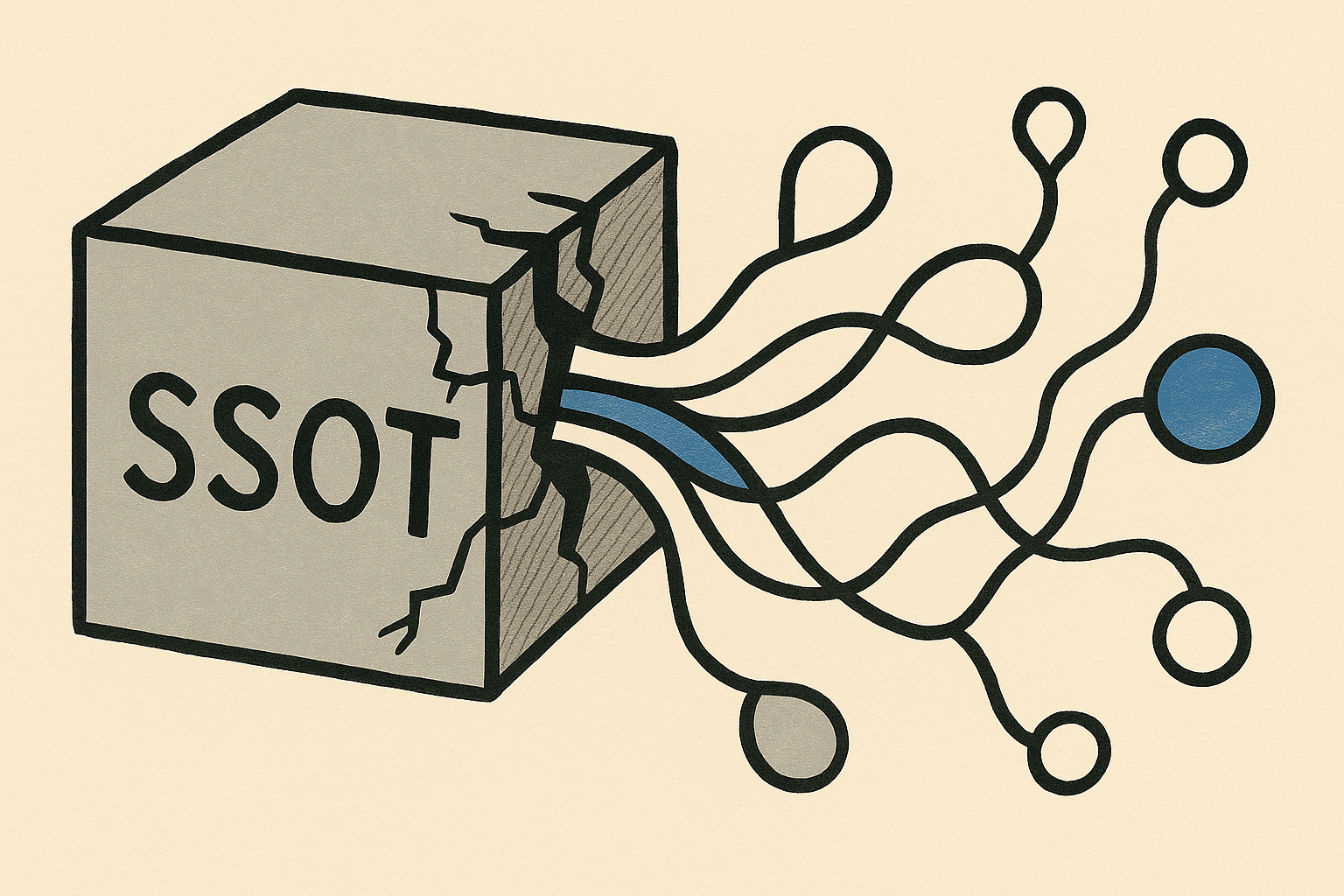
Hey, there! I hope you all had a great long weekend in the US, or have carved away some quality time in the rest of the world! I’ve been pretty quiet doing the same, but then also cobbling together some more actionable toolkits to share. For example, some unexpected things happened after I published the piece on distributed coherence:
- It was unexpectedly being referred to elsewhere. The bluff was called at the Button conference in the Slack channel this year! It’s a term now, a thing, but like all terms, it was interesting to see how it was being defined and applied; therefore, I should put some meat on the bones.
- Saying “SSOT is dead” was incendiary clickbait. One of our great luminaries Micheal Andrews (yes, you’re officially a ‘lum now), diplomatically brought up that while he loves being cited, a single source of truth for content is still needed for distributed coherence to even get going. So I’d like to take the time to apologize for my more baser instincts in the editorial and confirm that, yes, all of the frameworks in the world don’t matter if there’s no hygiene in place. AI is an enabler of content velocity, but it’s also an amplifier of content debt.
- The jazz metaphor resonated. The data about content failures validated what people were quietly experiencing. Also people who reported their teams internalized “shared structure, contextual interpretation” stopped trying to achieve identical content and start achieving coherent intent. That shift changes everything. But what I heard most often was: “Okay, I’m convinced. Now what do I actually do on Monday?”
Fair question.
The original article laid out seven strategies for implementing distributed coherence. But strategies without scaffolding leave people stuck between “this makes sense” and “where do I start?” So I built some scaffolding.
The Distributed Coherence Toolkit is a set of seven practical resources that turn the framework into action. Each one maps directly to a strategy from the original piece, designed to help you take the first real step.
What’s in the toolkit
1. Coherence Markers Worksheet The hardest part of distributed coherence is knowing what must stay consistent. This worksheet guides teams through identifying their non-negotiables—not surface elements like “we use sentence case” but deeper decisions about user agency, complexity handling, and trust-building approaches.
2. Adaptive Content Pattern Templates Templates enforce uniformity. Patterns enable appropriate variation. This resource provides starter patterns for common content types (feature introductions, error messages, help content), each showing required elements, contextual elements, and adaptation guidance. These are nothing new to most of you, but just tethered to the concept of distributed coherence.
3. Decision Framework Cards When should teams personalize vs. standardize? Be comprehensive vs. minimal? Match source language vs. culturally adapt? Let’s face it: I love cards, you do too. These cards provide clear criteria for distributed decision-making without constant escalation. These can be applied to in-person or your MURAL/Miro boards!
4. Content Source Types Matrix Not all content needs the same governance approach. The matrix helps teams categorize content into core, reference, operational, and conversational—each with different adaptation rules and review requirements.
5. Coherence Metrics Canvas Stop measuring whether content is identical. Start measuring whether it’s coherently purposeful. This canvas helps teams define metrics for brand coherence, functional coherence, value coherence, and operational coherence aligned to business outcomes.
6. Variation Rationale Log When content varies significantly across contexts, document why. This simple log template creates institutional knowledge that compounds over time—helping teams understand not just what varies, but the reasoning behind it.
7. Content Principle Cards Portable reference that works across 12+ channel types. Each card states a principle, then shows how to apply it in high-attention moments, ambient moments, and interruption moments. Teams can make contextually appropriate decisions without waiting for central guidance.
Ways to get the toolkit
I’ve been thinking about how to share this. A few options, depending on what fits your situation:
Free download (just share and branch)
The simplest approach: download everything, no strings attached. My only ask is that if you find it useful, share the original article with someone wrestling with their ecosystem or content operations. The ideas spread and get better when practitioners share with practitioners.
→ Download the full toolkit (free)
What I’ve learned from early users
A few patterns from teams who’ve tried the toolkit in beta:
Start with Coherence Markers. Everything else depends on knowing what must stay consistent. Teams who skip this step end up building patterns for variation without a clear sense of what they’re varying from.
The Decision Framework Cards are the hardest sell—and the biggest unlock. Content teams across many business groups are trained to get approval. Giving them frameworks to make decisions themselves feels scary until they realize it’s also faster and produces better contextual results.
Variation Rationale Logs compound fast. After a month, teams have institutional knowledge they didn’t realize they were missing. New people can understand why the mobile app says one thing while the help center says another. After six months, they can then adapt, change, remove or add more rationales based on ever-changing business rules.
Why I’m not putting this behind a paywall
Here’s my honest thinking: I believe distributed coherence is how content organizations need to work going forward. To repeat, you need to work from a source of truth to make this happen; however, treating all content as equal is actively holding teams back on scaling information while it’s just fostering consistency for the sake of consistency.
The more teams move into distributed coherence, the more the practice evolves. I’d rather see a thousand teams trying these tools and improving on them than a hundred teams paying for access and treating them as finished products. That’s a cargo cult.
That said, I do offer paid services for teams that want hands-on help. The toolkit is the scaffolding; facilitation is the skilled guidance.
So, if you’re thinking you could benefit from a 7-day email course, or your team could use a half-day workshop, I’d love to hear from you! I’d rather gauge if that’s a thing right after the holidays. In the meantime, here’s my gift to you.
One more thing
The feedback that surprised me most wasn’t about the framework. It was people saying the article gave them language for what they already knew was true.
They’d been managing distributed content while pretending it was single-source. They’d been handling exceptions they weren’t supposed to need. They’d been making contextual decisions while the governance model assumed uniformity.
Distributed coherence isn’t a new way to work. It’s naming what content teams are already doing and giving them better tools to do it well.
The toolkit makes that, if not official, a good start.
→ Get the Distributed Coherence Toolkit
What’s your experience with distributed coherence? Reply and let me know—I’m genuinely curious what’s working (or not) for content teams right now.
This is part of a series on the maturity of content design. Read the original: “Beyond Single Source of Truth: Designing for Distributed Coherence”
 Scott Pierce